How do you find your real maintenance calories?
Ultimate Guide to Maintenance Calorie Tracking
Maintenance calories are a small range—estimate, track 2–3 weeks, use 7‑day averages, and adjust by 100–200 kcal.
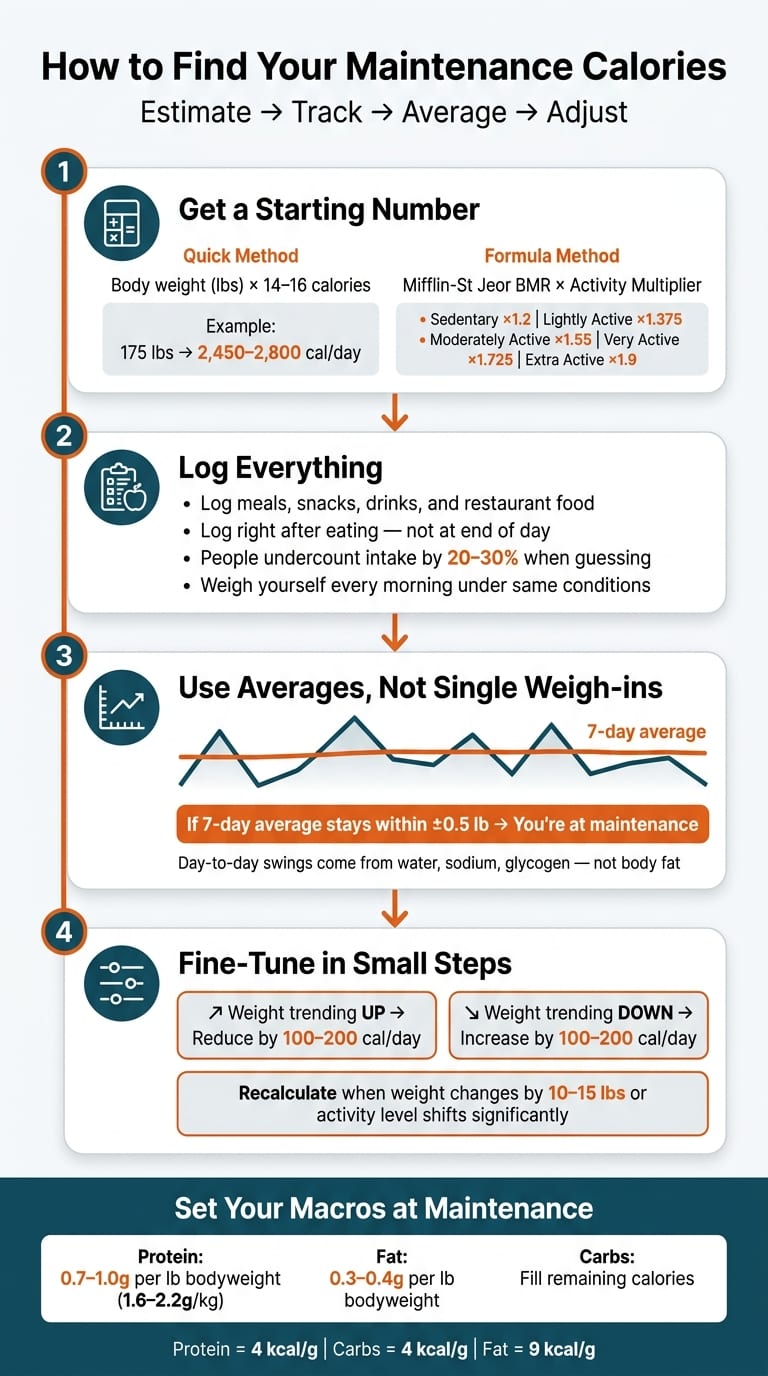
Your maintenance calories are not one fixed number. They’re a small range, and the best way I find that range is simple: estimate it, track food for 2–3 weeks, weigh in each morning, and watch the 7-day average.
If my weight stays within about 0.5 lb across those weekly averages, I’m close to maintenance. If it drifts up or down, I adjust by 100–200 calories per day. That works better than chasing one weigh-in or aiming for perfect daily numbers.
Here’s the short version:
- Start with an estimate: use body weight × 14–16 calories, or a BMR/TDEE formula
- Track for 2–3 weeks: log meals, snacks, drinks, and restaurant food using a calorie tracking guide
- Watch trends, not single days: both food intake and scale weight can swing from water, sodium, glycogen, and digestion
- Set macros simply: protein first, fat next, carbs with the rest
- Keep tracking low-friction: log right after eating, repeat a few meals, and review once a week
- Recheck your target: if your body weight changes by 10–15 lb or your activity changes a lot
A few numbers matter more than the rest:
- People often undercount intake by 20%–30%
- Maintenance is often within about 100–200 calories of target on either side
- Protein can land around 0.7–1.0 grams per pound of body weight
- Fat often works well around 0.3–0.4 grams per pound
How to calculate maintenance calories: TDEE explained
Quick comparison
| Method | What I need | Work level | Best use |
|---|---|---|---|
| Pounds-based estimate | Current weight | Low | Fast starting point |
| Mifflin-St Jeor + activity factor | Age, sex, height, weight, activity | Medium | Better first estimate |
| 2-week tracking check | Food logs + daily weigh-ins | High | Finding my actual maintenance |
| AI tracker like Welling | Basic stats + food and weight data | Low after setup | Long-term tracking with less manual entry |
The core idea is simple: estimate, track, average, and adjust. That’s how I keep maintenance calories from turning into guesswork.
How to calculate your maintenance calories
The goal here is simple: get a starting number, then check it against what your body does in real life.
Start with BMR, TDEE, and activity multipliers
Your total daily energy expenditure, or TDEE, comes from four main parts: BMR, TEF, NEAT, and exercise. Of those, NEAT explains a lot of why two people who look similar can need very different calorie intakes. In fact, it can differ by as much as 2,000 calories per day between two people of similar size.
A common starting formula for healthy adults is Mifflin-St Jeor:
- Men: BMR = (10 × weight in kg) + (6.25 × height in cm) − (5 × age) + 5
- Women: BMR = (10 × weight in kg) + (6.25 × height in cm) − (5 × age) − 161
If you use U.S. units, convert pounds to kilograms by dividing by 2.205, and inches to centimeters by multiplying by 2.54. After that, multiply your BMR by the activity factor that fits your day-to-day life best:
| Activity level | Multiplier | Description |
|---|---|---|
| Sedentary | 1.2 | Desk job, little to no exercise |
| Lightly active | 1.375 | Light exercise 1–3 days/week |
| Moderately active | 1.55 | Moderate exercise 3–5 days/week |
| Very active | 1.725 | Hard exercise 6–7 days/week |
| Extra active | 1.9 | Physical job or training twice a day |
If you’re between two categories, go with the lower multiplier first. That usually gives you a better starting point than guessing high.
Use a quick estimate, then verify with real data
If you just want a ballpark number, a fast shortcut is to multiply your body weight in pounds by 14 to 16. For a moderately active 175-pound adult, that puts maintenance around 2,450 to 2,800 calories per day.
That gives you a first target, not a final answer.
For the next two weeks, eat at that level, log everything you eat with a counting calories app, and weigh yourself every morning under the same conditions. Think of this as a reality check. Formulas are useful, but your daily intake and scale trend tell the real story.
If your 2-week average stays flat, keep the target. If your weight trends up or down, adjust by 100 to 250 calories. You should also recalculate when your weight changes by 10–15 lbs or your daily activity shifts in a big way.
Maintenance calculation methods compared
There isn’t just one way to do this. Some methods are fast and rough. Others take more work but give you a tighter number.
| Method | Required inputs | Effort | Typical accuracy | Best for |
|---|---|---|---|---|
| Pounds-based estimate | Current weight (lbs) | Very low | Low to moderate | Beginners wanting a quick starting point |
| Equation-based (Mifflin-St Jeor) | Age, sex, height, weight, activity | Moderate | Moderate (within 10%) | Starting a structured plan |
| 2-week intake & weight tracking | Daily food logs, morning weigh-ins | High | High | Confirming true maintenance after a diet |
| AI tracker (Welling) | Basic stats + ongoing data | Low (after setup) | Very high | Long-term maintenance — lowest ongoing effort after setup |
Once you have a calorie target you trust, the next step is turning that number into macro goals.
How to set macro targets at maintenance
Once you have a calorie target you trust, the next step is dividing it into protein, carbs, and fat. You do not need a perfect split. You need one that makes sense for your life and that you can follow without turning every meal into math homework by using the best food calorie apps to automate the process. At maintenance, consistency matters more than precision.
Start with evidence-based macro ranges
A good place to start is the AMDR: 45–65% carbs, 20–35% fat, and 10–35% protein. That range is pretty broad on purpose. Your ideal mix depends on how active you are and what you want maintenance to look like.
Protein deserves the most attention here. At maintenance, it helps with muscle retention and can make it easier to stay full. A simple target is 0.7 to 1.0 grams of protein per pound of body weight (1.6 to 2.2 g/kg). So for someone who weighs 175 pounds, that works out to about 122 to 175 grams per day.
Fat should usually stay around 0.3 to 0.4 grams per pound so intake doesn’t drift too low. After that, let carbs fill the rest. If you train hard or often, carbs will usually end up higher.
Use those ranges to pick a split that feels simple, then turn it into grams. If you’re unsure how to track calories and macros with these targets, AI tools can simplify the process.
Pick a simple split and convert calories to grams
Here’s what a 2,000-calorie target looks like with a 30% protein / 40% carbs / 30% fat split:
- Protein: 30% × 2,000 = 600 kcal ÷ 4 = 150g
- Carbs: 40% × 2,000 = 800 kcal ÷ 4 = 200g
- Fat: 30% × 2,000 = 600 kcal ÷ 9 = 67g
The math is simple: protein and carbs each provide 4 kcal per gram, while fat provides 9 kcal per gram. Start with a split like this and stick with it long enough to judge what’s happening with your hunger, energy, and body weight.
Macro patterns for maintenance compared
If you want a few easy starting points, here are common maintenance patterns at 2,000 calories:
| Split | Protein | Carbs | Fat | Primary benefit |
|---|---|---|---|---|
| Balanced (25P / 45C / 30F) | 125g | 225g | 67g | General health & sustainability |
| High-protein (35P / 35C / 30F) | 175g | 175g | 67g | Satiety & muscle retention |
| Higher-carb (20P / 50C / 30F) | 100g | 250g | 67g | Standard energy needs |
A high-protein split makes a lot of sense if you train on a regular basis or want more satiety and better muscle retention. If you’d rather keep things simple, the balanced split is a solid place to begin. Pick the one that fits how you eat day to day, then use it as your baseline.
How to track maintenance calories without making it a chore
Once your calorie and macro targets are set, tracking is what keeps them on track. Most people don’t quit because the numbers are hard. They quit because the process feels annoying. So the goal isn’t to find the “perfect” system. It’s to find one you can stick with every day.
Build a low-effort tracking routine
The habit that matters most is logging right after you eat, not at the end of the day. If you wait until bedtime, small things slip through the cracks. A snack here, a drink there, a handful of something while cooking — it adds up fast. Research shows people already underestimate how much they eat by 20% to 30% when they guess portions. Logging right away helps close that gap.
It also helps to use anchor meals. That just means repeating the same breakfast or lunch on most days. If breakfast is always two eggs, toast, and coffee, you can log it in a few seconds. Save it as a favorite and keep moving. That way, you save your brainpower for dinners, restaurant meals, and anything else that changes.
Your scale can help too, as long as you use it the right way. Weigh yourself each morning, then look at the 7-day average instead of getting hung up on one random number. Day-to-day shifts often come from water, sodium, and glycogen, not body fat. If your average keeps moving in the same direction, give it 2–3 weeks before changing your intake. And when you do make a change, keep it small — 100 to 200 calories at a time.
Manual logs, standard apps, and AI trackers compared
The main difference between tracking methods is friction. Manual logs ask the most from you. Apps cut some of that work. AI trackers cut even more.
| Method | Speed | Convenience | Macro detail | Restaurant handling | Adherence | Accuracy |
|---|---|---|---|---|---|---|
| Manual (paper/spreadsheet) | Slow | Low | High (if done manually) | Difficult | Low | Variable |
| Standard apps (MyFitnessPal, Cronometer) | Moderate | Moderate | High | Good (via database) | Moderate | High (if using a scale) |
| AI/photo trackers (Welling) | Fast | High | Moderate–high | Excellent (via AI/photo) | High | High (via trend adjustment) |
Why Welling works well for long-term maintenance tracking

If you want maintenance tracking to feel less like homework, Welling makes that easier with photo, chat, and voice logging. That’s especially helpful for restaurant meals and mixed dishes, where manual database searches can get old fast. It also gives you daily calorie guidance, macro tracking, and weekly trend feedback. On top of that, it can adjust calorie targets based on your food logs and weight trends.
Conclusion: how to find and keep your maintenance intake
Maintenance is a range, not one magic number. Formulas help you get started, but they don’t give you the final answer. The next step is simple: eat at your estimated intake for 2 to 3 weeks, weigh yourself each day, and compare your weekly averages. If your average stays within about 0.5 lb, you’re probably in the right spot. If it starts to move, adjust by 100–200 calories at a time.
What matters most is the weekly trend, not one scale reading. Day-to-day jumps are normal, and they don’t mean you’ve gained or lost body fat overnight. A salty dinner, a hard workout, or even a late meal can move the scale. That’s why a single weigh-in is just noise. The 7-day trend tells the real story.
You’ll also want to recalculate when your body weight changes by 10–15 lbs or when your activity level shifts. In practice, maintenance gets a lot easier when you lean on steady routines instead of trying to nail every day with perfect precision. Things like anchor meals, consistent morning weigh-ins, and a short weekly check-in can do a lot of the heavy lifting.
If you want tracking to feel more hands-off, Welling can adjust your calorie targets based on your food logs and weight trends. That makes maintenance easier to manage over time.